

Garnet: not quite as cubic as one might think
Bernardo Cesare – Dipartimento di Geoscienze, Università degli Studi di Padova
Distinguished Lectures in Earth Sciences
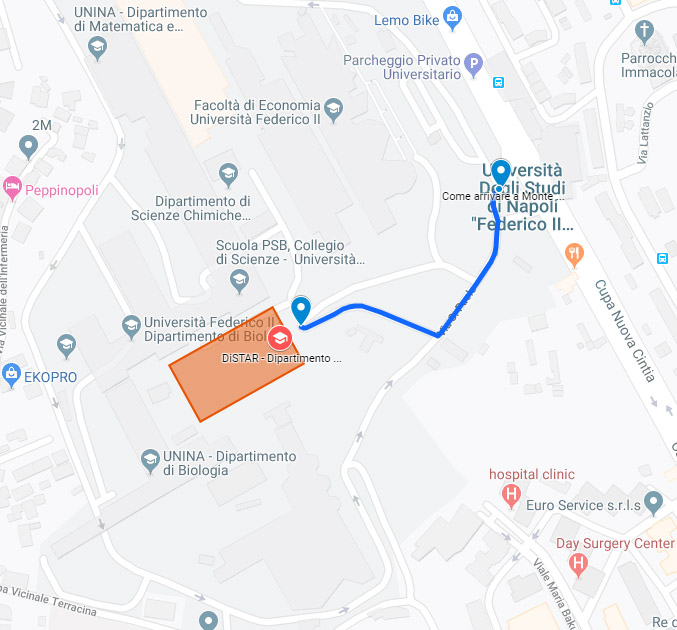
Giovedì 26 marzo, alle ore 16:15, presso l’Aula del Consiglio (DiSTAR, Edificio 10 – Complesso Universitario di Monte Sant’Angelo), Bernardo Cesare (Dipartimento di Geoscienze, Università degli Studi di Padova) terrà il seminario:
“Garnet: not quite as cubic as one might think”
Il seminario presenterà recenti sviluppi nello studio della struttura dei granati in rocce metamorfiche a bassa temperatura, evidenziando come deviazioni dalla simmetria cubica possano essere più diffuse di quanto comunemente ritenuto. Verranno discussi risultati ottenuti tramite microscopia ottica, spettroscopia Raman e tecniche avanzate di diffrazione e microscopia elettronica, aprendo nuove prospettive nella comprensione delle proprietà e dei processi di crescita dei granati.
Sono invitati a partecipare studenti, tesisti, dottorandi e collaboratori.
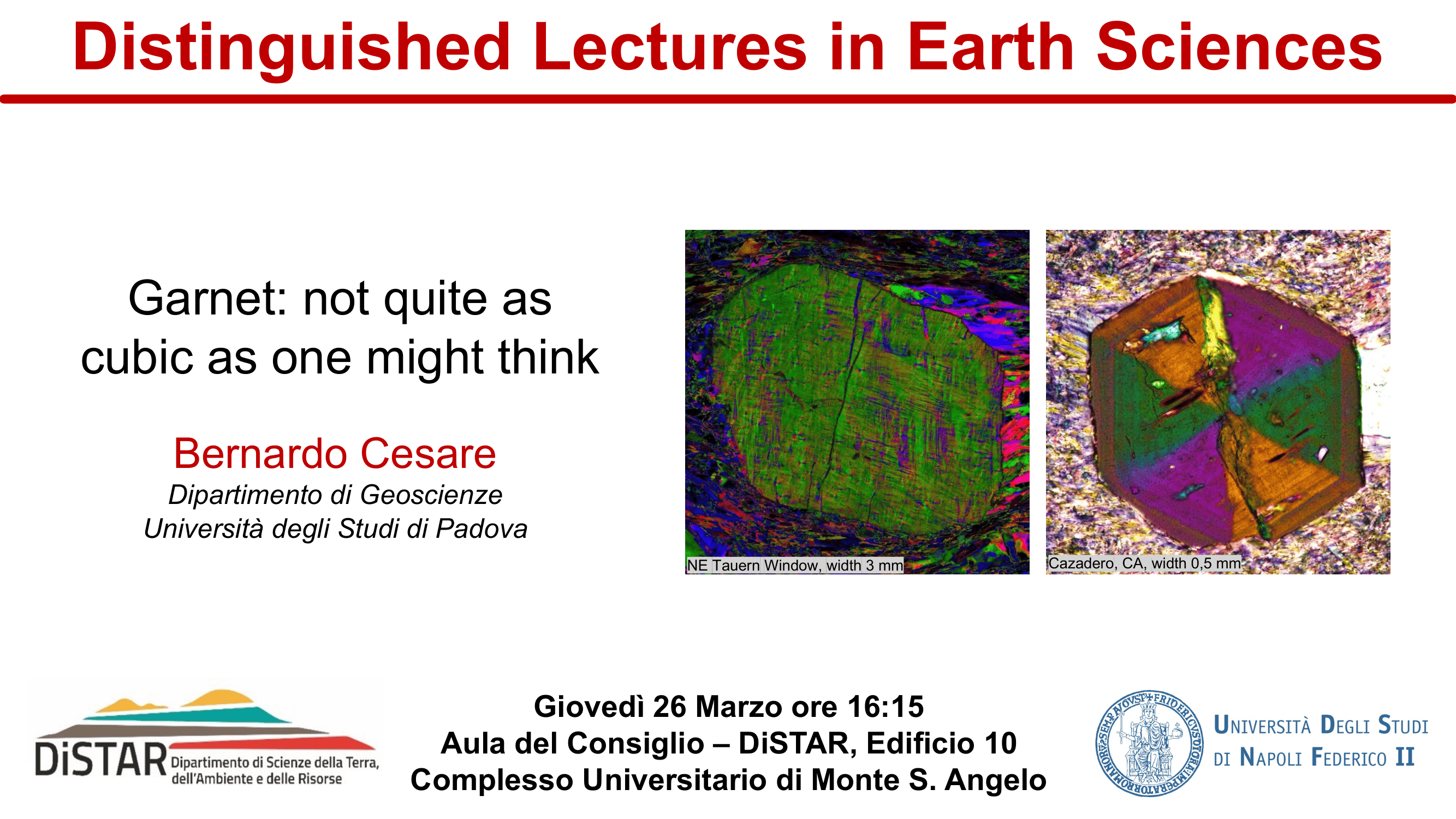
Since the first report in 2019 on the tetragonal structure of common garnet in low-T metamorphic rocks, many new occurrences have been discovered, including blueschists from the Franciscan Complex, Syros and Aosta Valley, and phyllites from the iconic Barrow garnet zone of Scotland and from the Alps. These garnets share compositional features such as grossular >20% and pyrope <7%, which are common in both metabasites and metapelites metamorphosed at T < ≈500-550 °C.
The non-isotropic nature of the garnets determines a very weak birefringence, which is generally overlooked, yet it can be easily detected by polychromatic polarization microscopy, and by Raman microspectroscopy. Optically, the birefringence pattern suggests the presence of twelve growth sectors (twins) arranged in a dodecahedron, having optical axes swapped by 90°.
Single-crystal XRD and HRTEM investigations have demonstrated that these anisotropic garnets have a pseudocubic tetragonal or orthorhombic structure with a minimal (≈ 1/1000) difference between the a, b and c axes. Due to the minimal departure from the cubic cell, conventional EBSD orientation analysis could not discriminate the orthogonal orientation of <c> axes in the optically different sectors, requiring further TEM characterization.
This presentation will report the state-of-the-art about non-cubic common garnets, discuss some new results and describe the new research avenues, suggesting that the anisotropy of garnet in low-T metamorphic rocks may be the rule rather than the exception.