

Il più forte terremoto mai registrato ai Campi Flegrei: ulteriori conferme sulla dinamica del sistema vulcanico
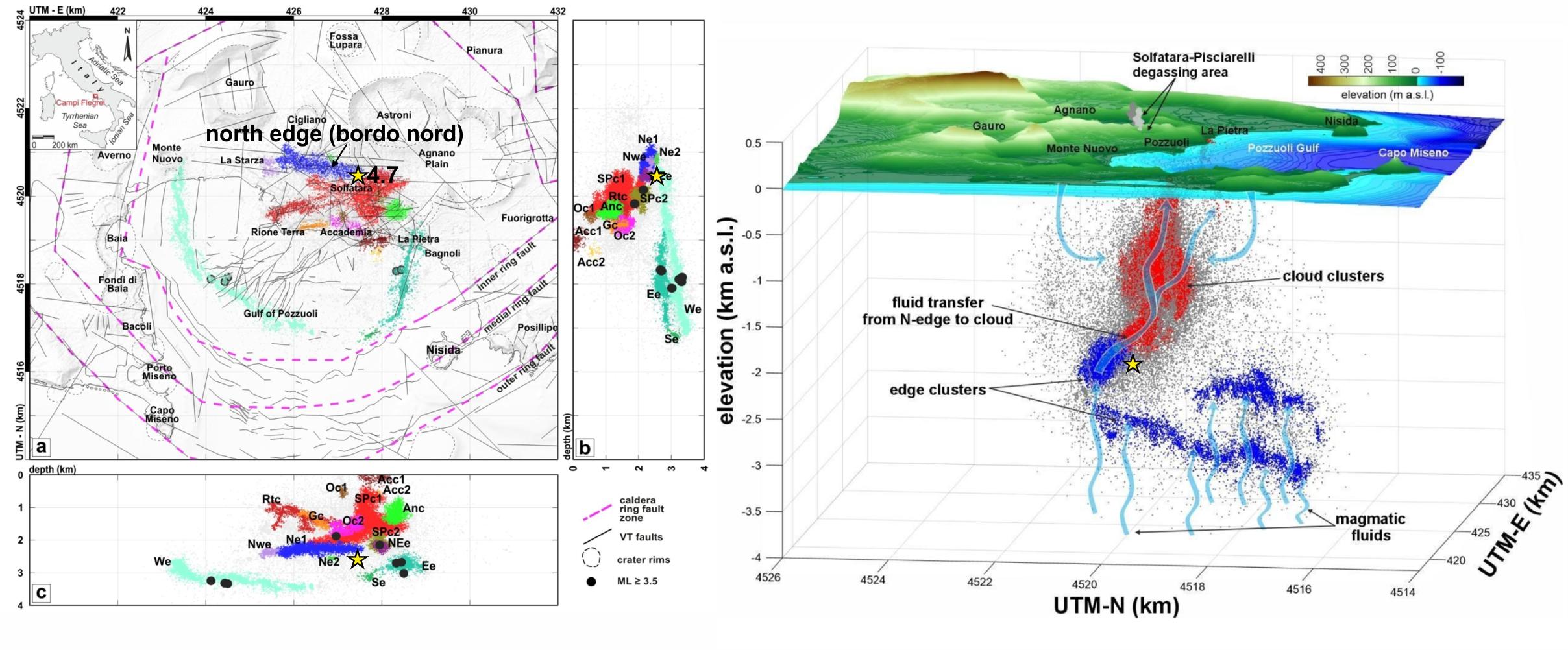
Il terremoto di magnitudo 4.7, avvenuto il 31 luglio 2026 alle ore 19:46, rappresenta il più energetico mai registrato nei Campi Flegrei da quando il vulcano è monitorato. Il terremoto è localizzato sul bordo nord (north edge) del volume sismogenico della caldera, che si sta delineando sempre più come un anello ellittico che confina la sismicità. Il bordo nord, sulla base dei dati di terreno, è attivo da 5000 anni e, in tempi recenti, ha sempre prodotto terremoti, che si allineano in una direzione circa ovest-est, da Cigliano alla Piana di Agnano. Sebbene l'ultimo evento sia il più grande registrato, risulta compatibile con quanto aspettato dai modelli sviluppati. Uno studio recente, presentato all’European Geosciences Union (EGU) 2026 (Selva et al., 2026), ha mostrato che la sismicità degli ultimi anni si dispone lungo un anello tra 2 e 4 km di profondità, che convoglia i fluidi magmatici (gas magmatici e/o fluidi idrotermali) che risalgono dalla profondità, e che il bordo nord trasferisce questi fluidi alla parte centrale della caldera (Pozzuoli-Solfatara-Pisciarelli), dove risalgono in superficie. Il terremoto è avvenuto proprio lungo questo bordo nord, a testimonianza che il trasferimento è attivo.
Il Dipartimento di Scienze della Terra, dell’Ambiente e delle Risorse dell’Università degli Studi di Napoli Federico II è da anni impegnato nello studio del bradisismo e dell’evoluzione geologica e vulcanologica dei Campi Flegrei, contribuendo alla ricerca scientifica su uno dei sistemi vulcanici più studiati e monitorati al mondo, per la sua complessità e l’elevata esposizione della popolazione. Questa esperienza si riflette anche nell’offerta formativa del Dipartimento: il Master internazionale in Volcanology, erogato in lingua inglese e realizzato in collaborazione con l’Osservatorio Vesuviano (INGV-Sezione di Napoli), offre a studenti italiani e internazionali una formazione multidisciplinare che integra geologia, geofisica, vulcanologia, petrologia e geochimica, fornendo gli strumenti necessari per comprendere i processi che caratterizzano i sistemi vulcanici attivi e per contribuire alla loro valutazione e gestione.
https://meetingorganizer.copernicus.org/EGU26/EGU26-11349.html?pdf
https://www.distar.unina.it/it/
https://www.volcanology.unina.it
English version
The strongest earthquake ever recorded at Campi Flegrei: further confirmation of the volcanic system dynamics
The Md 4.7 earthquake, which occurred on 31 July 2026 at 19:46, is the most energetic earthquake ever recorded in the Campi Flegrei caldera since systematic volcanic monitoring began. The earthquake is located along the northern edge of the caldera's seismogenic volume, which is becoming increasingly well defined as an elliptical ring that bounds the seismicity.
Based on geological field evidence, the northern edge has been active for approximately 5,000 years and, in recent times, has consistently generated earthquakes aligned along an approximately west–east trend, extending from Cigliano to the Piana di Agnano. Although the latest event is the largest ever recorded, it is consistent with the expectations of the models developed to describe the ongoing evolution of the caldera.
A recent study presented at the European Geosciences Union (EGU) General Assembly 2026 (Selva et al., 2026) showed that the seismicity of recent years is distributed along a ring-shaped structure between 2 and 4 km depth, which channels magmatic fluids ascending from deeper levels. The study also demonstrated that the northern edge acts as a preferential pathway, transferring these fluids toward the central sector of the caldera (Pozzuoli–Solfatara–Pisciarelli), where they eventually rise to the surface. The earthquake occurred precisely along this northern boundary, providing further evidence that this fluid-transfer system is currently active.
The Department of Earth, Environmental and Resource Sciences (DiSTAR) at the University of Naples Federico II has been studying the Campi Flegrei unrest and the geological and volcanological evolution of the caldera for many years, contributing to research on one of the world's most extensively studied and closely monitored volcanic systems due to its complexity and the high population exposure. This expertise is also reflected in the Department's educational activities. The International Master in Volcanology, taught entirely in English and developed in collaboration with the INGV–Osservatorio Vesuviano, provides Italian and international students with multidisciplinary training in geology, geophysics, volcanology, petrology, and geochemistry, equipping them with the knowledge and skills needed to understand the processes that govern active volcanic systems and contribute to their assessment and management.
https://meetingorganizer.copernicus.org/EGU26/EGU26-11349.html?pdf
https://www.distar.unina.it/it/
https://www.volcanology.unina.it